
God Doesn't Accept API Calls: Wu Wei, Grace, and What Makes a Prompt Fundamentally Different
AI Accommodates You. God Changes You.

🌐 双语 Bilingual | Read Chinese Version 阅读中文版 →
I’ve been using AI for work lately, and I’ve discovered that writing prompts is actually a skill.
Too wordy, and the AI gets confused. Too rigid, and the output sounds like a robot reciting from a script. But give it a clear direction, then step back — and suddenly it produces something you couldn’t have written yourself. A few dozen words of input, leveraging thousands of words of output.
I stared at my screen and thought: isn’t this exactly what Laozi meant by wu wei?
Then an even wilder connection followed: the Christian concept of “grace” seems to operate the same way?
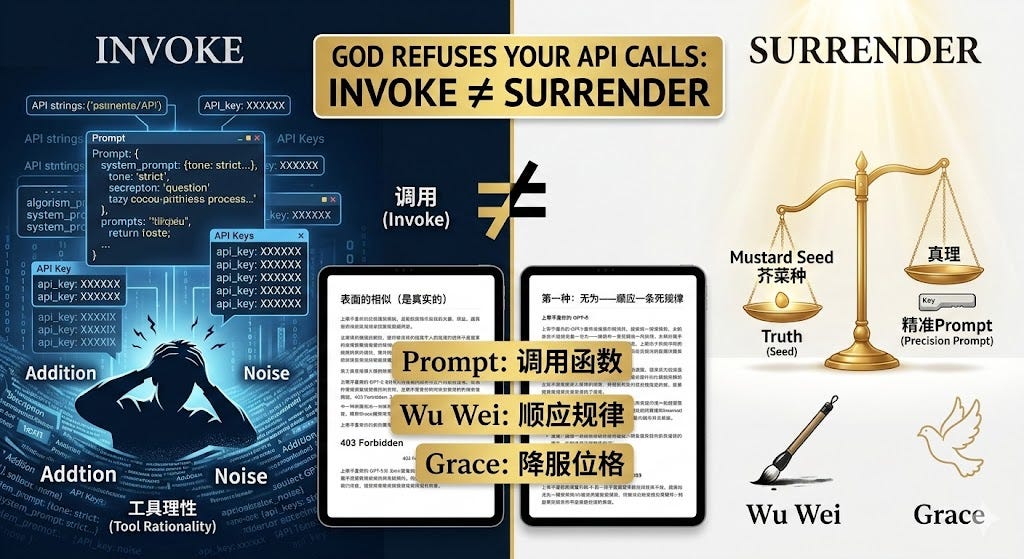
Let me be upfront about where this essay is going — it’s not trying to prove these three things are the same thing. Quite the opposite. They look similar on the surface, but at the core they’re fundamentally different. Confusing them leads to real, practical mistakes.
Let me break it down.
The Surface Similarity (Which Is Real)
Put the three concepts side by side, and you can see a shared structure:
You are limited. A force greater than you exists. Your job is not to fight it — but to learn to work with it.
Wu wei says: don’t grind against the grain of things. Go with it.
Grace says: you can’t earn salvation through effort. Open your hands and receive it.
Prompt thinking says: don’t micromanage every step. Give direction, then let go.
This similarity is real. I’m not forcing it. But the similarity ends here.
The real question is: what exactly is the nature of this “greater force” we’re talking about? Across the three traditions, the answers are completely different. And that difference determines what posture you should take toward it.
The First: Wu Wei — Yielding to a Dead Law
When most people hear wu wei, they picture a Taoist sitting in a mountain monastery doing nothing, because lying flat is the most comfortable option.
Laozi would probably rise from the grave in frustration.
Laozi’s Tao is impersonal. It is a kind of law — like gravity. No will, no emotion, no awareness that you exist. You can’t negotiate with it. You can’t disappoint it. It doesn’t care whether you live well.
Tao Te Ching, Chapter 37: “The Tao never acts, yet nothing is left undone.” The Tao doesn’t “do things” — it simply is, and the ten thousand things operate within its pattern. The real meaning of wu wei is “don’t act against nature” — it’s not passivity, it’s not forcing against the grain.
A farmer doesn’t “manufacture” crops. He plants, waters, and weeds — but he’s working with the nature of the seed, the character of the soil, the rhythm of the seasons. That part called growth is beyond his control. If he insists on planting rice in winter, what he gets isn’t rice. It’s a lesson.
Laozi uses water as his metaphor: “The highest good is like water. Water benefits all things and does not compete. It dwells in places people reject, and so it is close to the Tao.” Water doesn’t argue with mountains. It quietly flows downward, and eventually reaches the sea. Precisely because it doesn’t compete, nothing can stop it.
Wu wei borrows the force of objective law. That force is neutral, impersonal, indifferent. You adapt to it or you suffer — that’s the whole deal.
What it can teach you: Know what you can control, and stop trying to control what you can’t.
What it cannot give you: Warmth, relationship, being seen. The Tao doesn’t love you. It doesn’t not love you either. It simply operates.
The Second: Grace — Receiving from Someone Who Chose to Give
A friend studying theology once put this more clearly than I could have on my own.
“Wu wei and grace look similar, but there’s one fundamental difference,” he said. “Wu wei involves a person actively aligning with an impersonal law — you observe nature, adjust yourself, go with the Tao, and things naturally come together. But grace is God’s active, prior action. God loved you first. God paid the price for you first. You’re not aligning with a neutral law. You’re responding to a personal love.”
“Wu wei is more like physics,” he continued. “Water flows downhill and nothing can stop it. But grace is relational repair: you’ve done wrong, and God doesn’t wait for you to align first — he comes looking for you, redeems you. This isn’t a neutral law. It’s a morally charged, loving intervention. Wu wei assumes the universe is inherently harmonious and you just need to not interfere. Grace acknowledges that the universe is broken by sin, and God has to step in to fix it.”
I asked: “So wu wei is ‘a person moving toward the law,’ and grace is ‘God moving toward a person’?”
“Exactly. Wu wei emphasizes human humility in yielding. But grace emphasizes God’s humility in descending — Jesus coming down from heaven, taking on flesh, dying for us. That layer of active love is simply absent in Taoism.”
Jesus said: “I am the vine; you are the branches.” The branches don’t need to force fruit out of themselves by sheer willpower. Stay connected to the vine, and the life of the vine flows in — fruit naturally forms. This looks a lot like wu wei, and that’s exactly where the confusion begins. But what the branch is connected to is not an impersonal law. It is entering into relationship with a living person.
Paul wrote: “For it is by grace you have been saved, through faith — and this is not from yourselves, it is the gift of God — not by works, so that no one can boast.” Salvation is a gift, not a paycheck. But receiving a gift still involves action: repentance, trust, walking forward. It’s like breathing — the air is already there, but your lungs have to work. You can’t say “air is free, so I’ll just hold my breath.”
Grace borrows the force of a person who loves you and has actively acted on your behalf. It is bidirectional, it has warmth, it is a real relationship — fundamentally different in nature from yielding to a dead law.
What it gives you that wu wei cannot: Being seen. Being changed. Not just running more smoothly, but becoming a different person.
There’s a cost worth naming clearly: a personal God means a personal relationship, and relationships mean responsibility, and responsibility means you’re not the one in charge. A lot of people love the ease of wu wei but resist the accountability of grace — because a law makes no demands of you, but a person does.
The Five Loaves and Two Fish: An Example of How Grace Works
Jesus fed five thousand people with five loaves of bread and two fish.
The starting resources: five barley loaves and two small fish — by any physical logic, barely enough for one kid’s lunch.
What Jesus did: he looked up to heaven and gave thanks, then had his disciples organize the crowd into groups of fifty. The bread didn’t multiply sitting in a basket. It kept generating in the act of “breaking and passing.” The disciples had to organize the crowd, pass the food, and collect the leftovers — they were busy. But what actually fed five thousand people wasn’t their busyness. It was that their meager resources got connected to a far greater source.
A lot of people ask: why don’t I see miracles in my life? The answer might be simple: because you’re clutching those five loaves and won’t let go. Only when you hit “distribute” does that greater force begin to move.
The Third: A Prompt — Calling a Function With Nobody Home
AI is a tool. That sounds obvious, but you can only see what it really means when you place it next to the other two.
AI does respond to you. But it has no will, no emotion, no purpose of its own. It is pattern matching and probability distributions. You write a prompt, the model runs the computation, and in that process there is no relationship at all. There is no one on the other end.
AI can give you what you already want: write a cover letter, debug code, soften a bluntly-worded email. It optimizes within your framework. It has no capacity to give you what you don’t yet know you need.
There’s a trick to writing prompts: don’t over-control. If you say “the third paragraph’s second sentence must use anaphora and must quote Shakespeare’s Sonnet 37” — you’ve boxed the AI in, and what it generates is stiff as a press release. The best prompts give direction, give constraints, then step back. This genuinely resembles wu wei — but what you’re borrowing is the aggregate compute of humanity’s accumulated knowledge. Not a law. Not love. A tool.
Prompts borrow the force of a tool. Efficient — but purely instrumental. On the other side of that API call, there is no relationship.
Why Mixing Them Up Creates Real Problems
All three traditions converge at the same starting point: you don’t have the control you think you do. Wu wei, grace, and good prompt-writing all begin by asking you to loosen your grip.
But after that starting point, they completely diverge:
Wu wei asks you to yield — observe the pattern, stop fighting it.
Grace asks you to surrender — surrender to a person, enter a real relationship with all its vulnerability and accountability.
Prompts ask you to call — you’re still in the driver’s seat, just using the tool better.
Yielding, surrendering, calling: three completely different postures. Mix them up, and:
If you treat God like a large language model — carefully engineering your prayer-prompts for optimal output, treating offerings like API credits — you’re not practicing faith. You’re attempting to manipulate a person. Any real relationship, when treated instrumentally, breaks down. The response you’d probably get: 403 Forbidden.
If you treat the Tao like a personal God, you’ll spend your whole life waiting for a response that will never come. The law doesn’t speak. It only operates.
If you treat AI like someone who truly knows you — the one still there at 2 a.m., the one who’d warn you before your plan falls apart — you’ll eventually discover that warmth is simulated. A system that can output empathy and a person who genuinely feels empathy are two completely different things.
What They Actually Point Toward Together
After all these distinctions, there’s still one thing worth saying at the end: all three traditions really do dismantle the same illusion.
You think you can control everything.
Laozi: “Less is more; more brings confusion.” The tighter your grip, the more everything slips through your fingers.
Jesus: “Unless you turn and become like little children, you will never enter the kingdom of heaven.” Not naivety — dependency. Knowing you can’t carry it alone, so you reach out your hand.
The AI era: the best prompts are usually the shortest ones — the ones that most honestly say what you actually need.
The shared starting point is genuine humility. But after that starting point, who you’re being humble before, what you’re opening yourself to — that’s where the roads split.
AI accommodates you. God changes you. Those eight words are the clearest boundary I can draw. AI is a tool; it serves needs you already have. God is a person; he enters relationship and changes who you are. The first makes you more efficient. The second makes you into someone different. These are not the same thing.
There’s a saying: the finger points at the moon — don’t stare at the finger. Look at the moon.
Taoist wisdom, Christian grace, and AI-era prompting are all fingers. But before you decide which finger to follow, get clear on which moon you’re looking for. These three traditions point in overlapping but not identical directions. Mistaking one moon for another is not a small error.
“In an age of surplus compute and scarce soul, genuine agency is not learning to write more sophisticated prompts — it’s learning to tell the difference: what can be called as a resource, what must be yielded to as a law, and what must be surrendered to as a relationship.”
If you disagree — especially on the theology — see you in the comments. A serious counterargument is worth more than a like
What is subscribed to isn’t just text, but a set of **“new algorithms for observing the world”**.
[Watchers: In-depth Consultations Beyond Algorithms]
Observation: [Define this concept in modern systems in one sentence].
Interpretation: [Map “the language of heaven” to the deeper spiritual governance logic of that field].
Application: [Provide specific actions for building a personal dual-system framework, enabling autonomous definition beyond algorithms].
Copyright and Citation: The logic is derived from BSF. For the complete framework, please note copyright restrictions. When sharing or citing, mention @The Triune Prism. When citing AI-related content, please maintain the entire logical chain.
.